
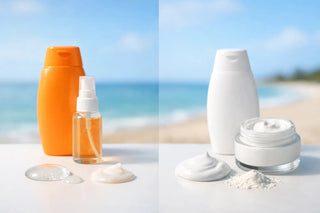
A sunscreen can look elegant on the shelf yet feel entirely wrong by lunchtime: too chalky beneath make-up, too rich for an active commute, or too prone to irritating already reactive skin. The chemical vs mineral sunscreen decision is therefore less about choosing a universally superior formula and more about finding broad-spectrum protection you will apply generously, comfortably and consistently.
For daily use in the UK, choose a broad-spectrum sunscreen with at least SPF 30 and high UVA protection. Whether its filters are mineral, carbon-based or a blend of both, the right formula is the one that suits your skin, routine and preferred finish.
Chemical vs mineral sunscreen: the essential difference
The two filter types are best described by what they are made of. Mineral filters use zinc oxide, titanium dioxide, or both - fine mineral particles that sit within the formula. The other type, often labelled 'chemical' on packaging and in search results, is more accurately called carbon-based: these filters are built around carbon, the same element at the heart of all living chemistry, rather than being anything unnatural or harsh. (You may also see them called 'organic' filters, which in chemistry simply means carbon-based - not natural or food-related.) For clarity, this guide calls the two types mineral and carbon-based. There are many carbon-based filters, and a formula may combine several to cover the UV spectrum.
The shorthand explanation is that mineral filters reflect UV rays while carbon-based filters absorb them. In practice, the science is more nuanced. Mineral filters also absorb a substantial proportion of UV radiation and convert it to a small amount of heat. Both categories can protect skin effectively when formulated to meet the stated SPF and UVA standards, and when applied in sufficient quantity.
The more useful distinction is often cosmetic. Carbon-based formulas can be exceptionally sheer, while mineral formulas may appeal to those who prefer a simpler filter profile or need a formula designed with sensitivity in mind. Neither description, however, guarantees how a particular sunscreen will feel or perform.
Understanding SPF and UVA protection
SPF measures protection chiefly against UVB, the rays most associated with sunburn. UVA reaches deeper into the skin and is linked with premature visible ageing, pigmentation and long-term skin damage - which is why daily SPF is the single most effective age-supporting step, as our guide to retinal versus retinol also explains. A high SPF alone is not the full picture.
When selecting sunscreen, look for broad-spectrum protection and strong UVA coverage. In the UK, the UVA symbol inside a circle indicates that UVA protection meets the required proportion of the labelled SPF. For prolonged outdoor exposure, holidays, sport or high-altitude conditions, SPF 50 is often a sensible choice, particularly for fair, photosensitive or pigmentation-prone skin.
No sunscreen provides complete protection. Shade, sunglasses, a hat and protective clothing remain valuable, especially between late morning and mid-afternoon when UV levels are strongest. UV can still be significant on overcast days and through car windows, so daily facial protection is a worthwhile part of a considered skincare routine.
Why carbon-based sunscreens are often chosen
Carbon-based sunscreens have developed far beyond the heavy, fragranced textures many people remember. Modern formulas can be fluid, invisible and comfortable on a wide range of skin tones. This makes them particularly appealing for daily wear, reapplication and use beneath make-up.
They can be an excellent choice for normal, combination or oily skin, especially where a weightless or matte finish encourages regular use. Many are formulated as gels, lotions, milks or light creams, allowing you to choose according to your preferred texture rather than filter category alone.
Those with deeper skin tones may also favour a carbon-based formula if avoiding a visible cast is their priority. While well-formulated mineral sunscreens are increasingly sophisticated, sheer carbon-based formulas tend to be easier to apply without leaving whiteness or requiring extensive blending.
There are trade-offs. Some people find particular carbon-based filters sting around the eyes, especially during exercise or in humid weather. A sunscreen can also irritate skin because of fragrance, alcohol, botanical extracts or the base formula - not solely because of the UV filters themselves. If your eyes water or your skin becomes uncomfortable, changing the whole formula is usually more helpful than assuming every carbon-based sunscreen will cause the same response.
The case for mineral sunscreen
Zinc oxide offers broad UV coverage, while titanium dioxide contributes particularly effectively to UVB protection. Mineral sunscreens are often selected for sensitive, reactive or post-procedure skin because they can be formulated with a minimal, gentle approach. They are also frequently favoured by those managing redness or seeking a fragrance-free daily option.
Their main consideration is finish. Zinc oxide and titanium dioxide can leave a pale or grey cast, particularly at higher concentrations and on deeper complexions. Tinted mineral sunscreens can be an excellent solution: iron oxides help soften the visible cast and may offer useful additional defence against visible light. This can be especially relevant for people prone to melasma or post-inflammatory hyperpigmentation.
Mineral formulas also vary widely. Some are rich and protective, making them well suited to dry or compromised skin. Others use sophisticated dispersions and silicone-based textures to feel lighter. It is worth judging the individual product, not the label alone.
Which sunscreen suits your skin concern?
If your skin is oily or blemish-prone, seek a lightweight, non-comedogenic fluid, gel or mattifying lotion. This may be carbon-based, mineral or hybrid. The finish matters because a sunscreen that feels too occlusive is unlikely to become a daily habit.
For dry skin, a creamier sunscreen with humectants, emollients and barrier-supporting ingredients can make morning skincare simpler. There is no need to separate skincare and sun protection rigidly if one well-formulated product keeps your skin comfortable.
For sensitive skin, choose fragrance-free where possible and introduce a new product carefully. Mineral sunscreen is a sensible starting point, but it is not automatically irritation-free. Patch test on the jawline or behind the ear for several days, particularly if you have eczema, rosacea or a history of contact allergy. Persistent irritation warrants advice from a pharmacist, GP or dermatologist.
For skin prone to pigmentation, prioritise high UVA protection, generous application and consistent reapplication. A tinted mineral formula may be particularly attractive for daytime wear, but an invisible carbon-based sunscreen with excellent UVA protection can be equally practical if it is the formula you will use faithfully.
Hybrid sunscreens offer a considered middle ground
Many premium formulas combine mineral and carbon-based UV filters. These hybrid sunscreens can pair the broad coverage and skin feel of different filters while reducing the challenges associated with using either category alone. They are worth considering if you like the idea of zinc oxide but want a more transparent finish, or if you need a carbon-based formula that feels more comfortable on sensitive skin.
A hybrid product is not inherently better. It simply gives formulators more flexibility with texture, protection and wear. Reading the product description for SPF, UVA rating, water resistance, finish and skin suitability will be more informative than relying on one headline ingredient.
Application matters as much as the formula
Even the most advanced sunscreen cannot provide its labelled protection when applied sparingly. For the face and neck, use a generous, even layer. The two-finger method - applying strips along the length of two fingers - is a useful everyday guide, although finger size and product texture mean it is not an exact measurement.
Apply sunscreen as the final step of your morning skincare routine, before make-up. Give it a moment to settle, particularly if you use a fluid formula. Reapply at least every two hours when outdoors, and immediately after swimming, towel-drying or heavy perspiration, even when the formula is water-resistant.
Do not overlook the ears, hairline, neck, chest and backs of hands. Lip products with SPF can add useful protection, but should also be reapplied regularly. If make-up makes reapplication difficult, a sunscreen stick, cushion or mist may help, though these should be applied generously enough to give meaningful coverage.
Common questions about sunscreen filters
Is mineral sunscreen safer than chemical (carbon-based) sunscreen?
Both mineral and carbon-based UV filters permitted in UK sunscreen products are assessed for use within regulated limits. The best choice depends on personal tolerance, desired finish and whether you can apply enough product. If your skin reacts, seek a fragrance-free option and consider professional advice rather than relying on broad claims about one category.
Does sunscreen need time to work?
Sunscreen should be applied before sun exposure so that you achieve an even, settled film on the skin. Mineral filters do not need to be chemically activated, but all sunscreens benefit from careful application before you leave the house.
Can I use the same sunscreen on my face and body?
Yes, provided it is comfortable and appropriate for your skin. Many people prefer a more refined facial formula for everyday wear and a larger-format, water-resistant product for the body. This is a matter of convenience and finish, not a requirement.
The most considered sunscreen choice is rarely about allegiance to mineral or carbon-based filters. Choose the texture that earns a place beside your morning skincare, apply it generously, and make reapplication part of the rhythm of days spent outdoors.