
When skin feels hot after washing, stings with products that once felt harmless, or flares for no obvious reason, the question becomes very practical: which skincare suits eczema? For most people, the answer is not a fashionable routine or a shelf full of actives. It is a disciplined choice of products that protect the skin barrier, reduce irritation and keep daily care as calm and consistent as possible.
For a broader view on choosing and using treatments appropriately, see our guide to over-the-counter remedies.
Which skincare suits eczema - the short answer
Eczema-prone skin generally does best with fragrance-free, low-irritant formulas designed to support the barrier rather than challenge it. That usually means a gentle cleanser, a suitable emollient or rich moisturiser used generously and frequently throughout the day.
For eczema-prone skin, emollients should ideally be applied at least 2–4 times daily and after washing. Washing with hot water can worsen itching and dryness. Short, lukewarm bathing followed by immediate emollient application is generally preferable.
When choosing products its worth remembering lotions are lighter in texture, creams are thicker and more nourishing, while ointments are the most occlusive and particularly useful when extra barrier protection is needed.
Check for targeted products with proven soothing and replenishing ingredients such as ceramides, glycerine, colloidal oatmeal, squalene or similar lipid-supporting ingredients.
What tends not to suit eczema is just as important. Strong acids, highly perfumed products, harsh exfoliants, drying foaming cleansers and overcomplicated routines can all make compromised skin feel worse. Even products marketed as natural or luxurious can be unhelpful if they contain essential oils or fragrant botanical extracts.
Why eczema changes the rules of skincare
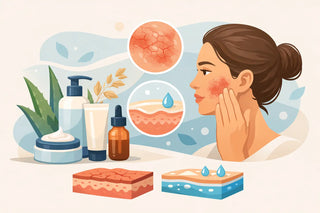
With eczema, the skin barrier is often weaker than it should be. Moisture escapes more easily, and irritants can get in more readily. That is why skin may become dry, rough, itchy and reactive all at once.
In practical terms, this means skincare should be judged less by trend-driven claims and more by tolerance. A cream can feel elegant, expensive and beautifully packaged, but if it stings on application or leaves skin tighter an hour later, it is not the right choice. For eczema, suitability is measured by comfort, consistency and reduced flare potential.
There is also an important distinction between skin that is dry and skin that has eczema. Dry skin may simply need more moisture. Eczema-prone skin often needs moisture plus protection plus a careful avoidance of triggers. That is why routines that work for general dehydration can fall short here.
The ingredients most likely to help
If you are trying to decide which skincare suits eczema, start with ingredient families rather than marketing language. Humectants such as glycerin and hyaluronic acid draw water into the skin. These can be helpful, though they tend to work best when paired with richer ingredients that help hold moisture in place.
Barrier lipids are often especially useful. Ceramides, cholesterol and fatty acids help replenish what eczema-prone skin may be missing. They support the skin’s structure and can improve comfort over time. Squalane can also be a good choice, particularly in moisturisers that need to feel nourishing without becoming overly heavy.
Occlusive ingredients deserve attention too. These help reduce water loss and support the skin barrier, particularly in periods of intense dryness or during colder weather. Heavier ointments, including those based on petrolatum, can be very effective for short-term protection, though many people prefer more cosmetically comfortable creams and balms for everyday use, with suitable options available within our eczema range.
Colloidal oatmeal is another ingredient worth considering. It can help soothe itch and calm the feeling of irritation, which makes it particularly useful when skin is uncomfortable but you want to avoid more aggressive interventions.
Niacinamide can be beneficial for some eczema-prone skin because it supports the barrier, but it is not universally tolerated, especially at higher percentages. This is where restraint matters. A lower-strength formula may suit sensitive skin far better than a concentrated treatment.
Ingredients and product types that often cause problems
Fragrance is one of the most common issues, whether synthetic or derived from essential oils. For eczema-prone skin, unscented or fragrance-free is usually the safer route.
Strong exfoliating acids, retinoids and highly active vitamin C formulations can also be difficult. That does not mean everyone with eczema must avoid them forever, but they rarely belong in the middle of a flare. If introduced at all, it should be cautiously and with a clear reason.
Foaming cleansers can be another hidden problem. Skin that already feels dry and tight after cleansing is often being stripped too aggressively. Likewise, alcohol-heavy toners, facial scrubs and peel pads tend to create more instability than benefit.
Even products labelled clean, botanical or natural require scrutiny. Plant extracts can be soothing, but they can also be sensitising. Eczema-prone skin is usually better served by a simpler formula with fewer potential triggers.
Which skincare suits eczema by product type
Cleansers
A suitable cleanser for eczema should remove grime, sunscreen and excess oil without leaving the skin squeaky or taut. Cream, milk and balm cleansers are often preferable to strong gels or foams, with gentle options available within our eczema cleanser range.
For some people, a morning cleanse with water alone followed by moisturiser is enough, with a proper gentle cleanse reserved for evening. That can be particularly helpful during colder months or when indoor heating is making skin more reactive.
Moisturisers
This is where eczema skincare usually succeeds or fails. Look for creams or balms rather than lightweight lotions if dryness is persistent. A well-formulated moisturiser should do more than soften the skin for a few minutes. It should reduce tightness, improve comfort and help the skin stay settled between applications, with suitable barrier-supporting formulations available within our eczema moisturiser range.
Texture matters, but not in the way beauty marketing often suggests. Richer is not always better if a formula feels suffocating or triggers heat and itch. Equally, a light gel-cream may feel elegant but offer too little support. The right choice is the one you will use consistently and generously.
Serums and treatments
Many eczema-prone complexions do not need a traditional treatment serum at all. If a moisturiser is doing its job, adding multiple extra steps can create confusion and increase the chance of irritation. Where a serum does make sense, it should have a straightforward purpose, such as hydration or barrier support.
Sunscreen
Sun protection remains essential, especially if you are managing post-inflammatory marks or using any active ingredients under professional guidance. The difficulty is that some sunscreens can sting compromised skin. Fragrance-free sunscreens formulated for sensitive skin are often best tolerated. Some people prefer mineral formulations, though tolerability varies by individual and formulation.
Suitable fragrance-free sunscreens formulated for sensitive or eczema-prone skin options designed with sensitivity in mind can be found within our sun protection range.
How to build a routine when your skin is flaring
During a flare, the best routine is usually the simplest one. Cleanse gently, moisturise well, and avoid experimenting. This is not the moment for exfoliation, potent anti-ageing products or brightening treatments.
Apply moisturiser on slightly damp skin to help trap water in the upper layers. Reapply through the day if needed, particularly on areas that feel rough, cracked or prone to itching. At night, a richer balm or ointment can be useful, especially around the eyes, mouth or hands, with protective formulations available within our eczema range.
During flares, prescribed topical corticosteroids may be necessary to reduce inflammation. When used correctly and for the recommended duration, they are an important and effective part of eczema management.
Skincare products should support them rather than compete with them. That means choosing bland, compatible formulas and avoiding anything likely to sting over sensitised skin.
Seek medical advice if eczema becomes increasingly painful, hot, weepy, crusted, or develops yellow discharge, as this may indicate infection.
Which skincare suits eczema in everyday life
Outside a flare, there is often more flexibility, but not unlimited freedom. Some people can tolerate a carefully chosen active once or twice a week. Others do best maintaining a permanently minimalist routine. The point is not to chase a perfect ten-step regimen. It is to understand your own skin’s threshold.
Patch testing is worthwhile, especially with any new cleanser, sunscreen or treatment. Introduce one product at a time and give it long enough to show its character. Eczema-prone skin does not always react instantly; sometimes a product seems fine for several days before irritation appears.
It is also sensible to think beyond the face. Body wash, hand soap, shampoo residue, laundry detergent and even fabric friction can affect eczema. Skincare may be the centre of the conversation, but it is rarely the whole story.
When to seek more than skincare
Skincare can make eczema easier to live with, but it is not always enough on its own. If skin is painful, weeping, infected, widespread, interrupting sleep or not improving with careful moisturising, professional advice matters. The same applies if you are unsure whether you are dealing with eczema at all, because rosacea, contact dermatitis and psoriasis can sometimes be mistaken for one another.
A refined routine is valuable, but eczema often requires a broader view. Climate, stress, allergens and irritation from daily life all have a role. Good skincare helps create stability. It cannot remove every trigger.
The most suitable skincare for eczema is rarely the most dramatic. It is the formula you reach for without hesitation because it comforts the skin, preserves the barrier and asks nothing extra of it. When skin is prone to flare, that kind of quiet reliability is a luxury in its own right.
If you are unsure which skincare products are most suitable for eczema-prone skin, speaking to a pharmacist can help. At John Bell & Croyden, our pharmacy team can help guide you towards suitable emollients, cleansers and barrier-supportive skincare.
For those managing eczema-prone skin, carefully selected products designed to support the skin barrier and reduce irritation can be found within our eczema range.