

AromeManpo: The Flower That Blooms at Night
Tuberose is a difficult flower to love in moderation. It opens after dusk, releases its scent long after it has been cut, and has spent three centuries being described by perfumers in the language of intoxication rather than comfort. It is not the obvious raw material for a brand whose central proposition is calm.
Which is rather the point. AromeManpo — founded in 2013 beside the Grand Canal in Hangzhou — has built an entire house around the idea that the flower most associated with excess can be turned towards restoration. This month, for the first time, British consumers can meet it: the brand opens a pop-up at John Bell & Croyden on Wigmore Street from 20th July to 2nd August, its first retail presence in Europe.
A European System, an Eastern Hand
The brand’s founder came to skincare through aromatherapy, with over a decade of practice behind the first formulation. That lineage matters, because it explains the brand’s unusual grammar. AromeManpo follows the European aromatherapeutic system; the structured, clinical tradition that Britain knows well through its own herbalist and pharmacy culture but reads it through Eastern botanical wisdom and, crucially, through fermentation.

Fermentation is where the brand stops being a fragrance story and becomes a science one. AromeManpo cultivates rare single-petal tuberose in the highland valleys of southern Yunnan, at latitude 23°N, where sharp day-to-night temperature swings and intense sunlight concentrate the plant’s active compounds. That material is then processed through Tubefermem, the brand’s proprietary fermentation complex, using an “Oriental Red Yeast” selected across more than three hundred trials. The process reduces the molecular weight of the active compounds while raising their total bioactive content — in plain terms, smaller molecules, more of them, better absorbed.
The work is protected rather than merely asserted. The brand holds granted Chinese patents covering both its tuberose fermentation solution and its tuberose extract, with further filings pending on flower wax and bulb extraction, and its findings on tuberose extract and melanogenesis have been published in a peer-reviewed, SCI-indexed journal.
The Emotional Skincare Question
“Emotional skincare” is a phrase that ought to invite scepticism, and in the British market it will. AromeManpo’s answer is that it is treating the category as a research problem rather than a marketing one.
In 2024 the Shanghai Daily Chemical Products Association issued group guidelines for the development and technical evaluation of emotional skincare cosmetics , a formal standard dividing the field into products that act on the senses and products that act on emotion-related pathways within the skin itself. AromeManpo is pursuing both. Its cellular work indicates that tuberose-derived materials can moderate cortisol, the stress hormone implicated in oxidative stress, inflammation and hyperpigmentation, and that its bulb extract may encourage the release of β-endorphins. A further study, using EEG alongside subjective questionnaires and efficacy instruments, is examining whether the scent itself measurably shifts mood and, through it, skin condition.
This is early science, and the brand presents it as such: a line of enquiry with published groundwork, not a settled claim. But it is a more serious attempt to evidence the “skin–mind axis” than most brands trading on the same territory have bothered to make.
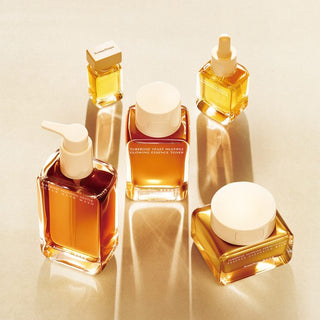
The Collection?
The Tuberose Glowing Fermentation Series is a complete regimen rather than a hero product with satellites: cleansing balm, toner, face essence oil, bath & shower body oil and an eye oil. The signatures are amber-gold formulas, high natural-derivation percentages, and a preference for oils where most Western routines reach for water. Independent third-party testing supports improvements in radiance, hydration and elasticity across the range.
Architecture as Argument
AromeManpo is perhaps best understood through its spaces. Maison Arome on Donghu Road in Shanghai occupies a house rather than a shop. Crimson Space in Nanjing draws on the city’s centuries-old crimson dyeing craft. Verde Space in Hangzhou is built from recycled materials; Swirling Space stages a shower as a rainfall; the Tuberose Gallery refuses enclosure altogether, sitting under glass on a lawn with a mechanical tuberose that opens and closes like a living thing.
None of this is decoration. It is the brand arguing, in built form, that skincare is a pause rather than a purchase — and it is the sensibility the Wigmore Street pop-up is designed to translate.

Why London, and Why Now?
John Bell & Croyden is not a conventional beauty launchpad. It is a pharmacy with two centuries of history, and its customers arrive expecting evidence. For a brand whose case rests on patents, clinical data and a genuine aromatherapeutic lineage, that is a natural room,
It is also a test. Chinese prestige beauty has spent a decade being discussed in Europe largely as a market rather than a source. AromeManpo arrives with the science, the design language and the commercial track record to reverse the direction of travel.