
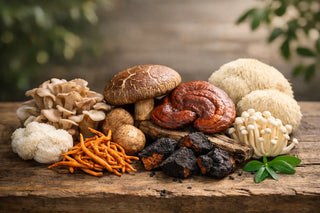
When customers ask about the best mushrooms for immunity, they are rarely asking one simple question. More often, they want to know which mushroom is worth their time, which format is credible, and whether a daily supplement can genuinely support resilience rather than merely sound impressive on the label.
Functional mushrooms have moved well beyond niche wellness circles, but popularity can blur quality. Different species contain different compounds, extraction methods matter, and the most suitable choice depends on whether you want broad everyday support, a more targeted option during demanding periods, or a formula that sits comfortably within a considered wellness routine.
Although functional mushrooms are increasingly popular in wellness routines, clinical evidence supporting their role in immune health remains limited, and effects may vary between individuals and formulations.
No supplement should be considered a substitute for core health measures such as adequate sleep, balanced nutrition, exercise, and appropriate vaccination
If you are exploring the category in more detail, it can help to understand how different species are used, as explained in our guide to functional mushrooms and how they work.
What makes certain mushrooms good for immune support?
The mushrooms most often associated with immune health are valued for naturally occurring beta-glucans and other compounds that have been studied for their interaction with aspects of the immune system. Rather than acting like a stimulant, many are studied for their potential role in immune-related processes - helping the body respond appropriately instead of simply pushing it harder.
That distinction matters. Immunity is not just about “more”; it is about balance. Sleep, stress, nutrition, movement and gut health all shape immune function, and mushrooms should be viewed as part of that wider picture. For many people, they make the most sense as a steady, longer-term addition rather than a quick fix.
The best mushrooms for immunity
Reishi
Reishi is often the first name mentioned in premium mushroom formulas, and with good reason. Traditionally prized for its broad wellness profile, it is widely discussed in relation to immune-related research, alongside its adaptogenic reputation, which appeals to those whose immune resilience may be undermined by stress and poor recovery.
It is not usually the mushroom people choose for culinary pleasure - reishi is bitter and typically taken as an extract, capsule or powder. For customers seeking a more elegant, all-round option, reishi often earns its place because it supports more than one wellness goal at once. If your interest in immunity sits alongside sleep quality, stress load or general restoration, it is a strong contender.
Shiitake
Shiitake sits at an interesting intersection of food and supplementation. Many people know it as a culinary mushroom, yet it also contains notable beta-glucans and other constituents often discussed in the context of immune health, although clinical outcomes in humans remain under investigation. For customers who prefer the idea of wellness grounded in recognisable ingredients, shiitake can feel more approachable than some of the more specialised medicinal varieties.
That said, eating shiitake in meals and taking a concentrated shiitake extract are not equivalent. A shiitake supplement is generally chosen for consistency and potency, while dietary use contributes to an overall health-supportive pattern. If you want a gentle entry point into mushroom wellness, shiitake is often one of the more intuitive places to start.
Maitake
Maitake is another mushroom with a strong reputation in discussions around immune health, again thanks to its beta-glucan content, although clinical outcomes in humans remain under investigation. It is frequently discussed alongside shiitake, but it tends to feel a little more specialist and is often included in blends designed for comprehensive immune and metabolic wellbeing.
For some, maitake is particularly appealing because it does not carry the same overtly calming identity as reishi or the cognitive association of lion’s mane. It is a more straightforward choice when immunity is the primary concern, with suitable options available within our range of maitake supplements. If you prefer formulations built around evidence-led functional ingredients rather than trend-led names, maitake is worth considering.
Chaga
Chaga is often positioned as an antioxidant-rich mushroom, and that is part of its appeal. While conversations around immunity should not be reduced to antioxidant claims alone, oxidative stress is often discussed alongside broader aspects of health, including immune resilience. This makes chaga a useful inclusion in more holistic formulas.
Chaga may not be suitable for everyone, particularly those taking blood-thinning medicines, diabetes treatments, or those with kidney-related concerns.
Its earthy profile has also made it popular in powders and mushroom beverages. The caveat is that chaga’s reputation can sometimes outpace the nuance. It may be a valuable part of an immune-supportive routine, but it is not automatically the best standalone choice for everyone, with suitable options available within our range of chaga mushroom supplements.
Cordyceps
Cordyceps is more commonly associated with energy, stamina and performance, yet it still appears in many blends positioned around wider wellbeing, including immune health. This is where context matters. If your energy is under strain, recovery is inconsistent and you are looking for support that feels less sedative than reishi, cordyceps may make more sense within your routine.
It is not the most obvious first choice if your sole priority is immune support. However, wellness is rarely neatly divided into categories. For busy professionals balancing long days, travel and training, cordyceps can be a pragmatic choice because it is commonly included in wellness routines focused on energy, stamina and recovery rather than immune support alone.
Lion’s mane
Lion’s mane is best known for cognitive support rather than immunity, so it may seem an unexpected inclusion here. Yet many modern mushroom formulas are designed around overlap - stress, focus, gut health and immune resilience are not entirely separate concerns.
If you are already drawn to lion’s mane for clarity and concentration, an intelligently blended formula that includes it alongside more immunity-focused mushrooms can be a sophisticated option. On its own, however, lion’s mane would not usually top the list of the best mushrooms for immunity.
Should you choose one mushroom or a blend?
A single-mushroom supplement can be the right choice when you have a clear purpose. Reishi for broad resilience or maitake for targeted support can be sensible, especially if you want to understand exactly what you are taking.
Blends, however, are often where premium formulation becomes most useful. A well-designed combination can bring together complementary mushrooms rather than relying on one hero ingredient. The key is thoughtful design. Some blends are thoughtfully dosed and properly extracted; others simply list fashionable mushrooms in amounts too small to be meaningful.
For many customers, a blend offers practical elegance - fewer products, broader support, and a routine that feels easier to maintain, particularly when exploring options within our wider range of functional mushroom supplements.
How to judge quality in mushroom supplements
This is where the category can become uneven. The front of the pack may name an impressive mushroom. The real value lies in the detail. Fruit body extracts are often preferred over products made predominantly from mycelium grown on grain, especially if you are looking for concentrated active compounds. Extraction method also matters, because some beneficial constituents are best accessed through hot water extraction, while others may require dual extraction.
Standardisation can be helpful, particularly when it refers to beta-glucan content rather than vague polysaccharide claims. Transparency around sourcing, species identification and extract ratio is also a mark of a more credible product.
Price should be considered with some care. Mushroom supplements can look similar while differing greatly in quality. A cheaper option may not be poor, but if it lacks detail on extraction, standardisation or the part of the mushroom used, you may be paying for little more than a trend.
Which format is best?
Capsules are the most straightforward. They suit customers who want convenience, consistency and no interference with taste. Powders can work well if you enjoy incorporating supplements into coffee, smoothies or evening drinks, though flavour varies considerably between mushrooms.
Liquids and tinctures appeal to those who value flexibility or prefer not to swallow capsules. However, not every liquid product is equal, and alcohol content, extraction quality and concentration should be assessed carefully.
There is no universally superior format. The best option is the one you will use consistently and that comes from a manufacturer with a strong standard of formulation.
Who should be cautious?
Anyone with a medical condition, those who are pregnant or breastfeeding, or those taking prescription medication should seek advice from a healthcare professional before using functional mushrooms. This is particularly important for people with bleeding disorders, diabetes, immune-related conditions, or those due to undergo surgery. Extra caution is advised for anyone taking immunosuppressants. “Natural” does not always mean suitable for every person or every situation.
It is also wise to watch for digestive tolerance. Even high-quality mushroom supplements may not suit everyone immediately, particularly in concentrated forms. Starting at the lower end of the suggested dose is often a sensible approach.
A more considered way to choose
For most people, the best mushrooms for immunity are not the most fashionable ones but the ones that fit their wider needs, are properly formulated and can be taken consistently. Reishi is often included as part of broader wellbeing routines, maitake is frequently discussed in more targeted immune-related contexts, and shiitake offers an approachable bridge between nutrition and supplementation.
At John Bell & Croyden, that principle of curation matters. In a category crowded with marketing shorthand, the strongest choices tend to be the ones backed by clarity, quality and a realistic role within everyday wellbeing.
If you are choosing carefully, think less about finding a miracle ingredient and more about building a routine that fits quietly into your wider wellbeing, day after day.