
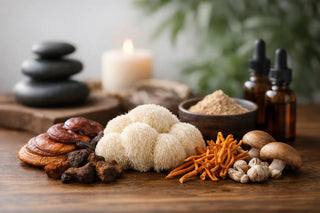
A racing mind at 11pm, another overfull week, a calendar that leaves little room to recover - stress rarely arrives as a single dramatic event. More often, it builds quietly. That is why interest in the best mushrooms for stress has grown so quickly among people who want support that feels considered, not extreme.
Medicinal mushrooms sit at an interesting point between tradition and modern wellness. They are not sedatives, and they are not a shortcut through chronic pressure. They are often used to support general wellbeing, focus and recovery, particularly when stress shows up as mental fatigue, poor sleep, irritability or that familiar wired-but-tired feeling.
What makes certain mushrooms useful for stress?
When people talk about mushrooms for stress, they are usually referring to functional mushrooms used in supplements rather than culinary varieties. Many are marketed as adaptogenic ingredients, a wellness term commonly used for products associated with resilience and stress support. In simple terms, they are often discussed in relation to how the body responds to physical and mental strain.
That does not mean every mushroom works in the same way. Some are chosen for their calming reputation, others for cognitive support, and others for energy that feels smoother than a sharp caffeine lift. The right choice depends on how stress affects you.
If your stress tends to disturb sleep and leave you feeling overstimulated, one option may stand out. If it shows up as brain fog, low concentration or emotional flatness, another may be more suitable. This is where curation matters - not just the ingredient itself, but the extract strength, the part of the mushroom used, and the wider formulation.
Although functional mushrooms are increasingly popular in wellness routines, evidence for their effects on stress, sleep and cognitive wellbeing is still developing, and individual responses can vary.
Best mushrooms for stress and how they differ
Reishi for calm and recovery
It is the mushroom most closely linked with a calmer profile. Reishi is commonly used in wellness routines focused on relaxation, rest and general wellbeing, although clinical evidence for stress support remains limited. People often reach for it during periods of tension, restlessness or feeling unable to switch off, with suitable options available within our range of reishi mushroom supplements.
Its appeal lies partly in what it is not. Reishi is not usually taken for an instant effect or a stimulating boost. It is better suited to evening routines or to periods when the goal is to feel more grounded over time. For those who are already highly driven, this gentler profile can be especially appealing.
That said, reishi is not ideal for everyone. Some people looking for daytime sharpness may find it less aligned with their goals than a more focus-led mushroom. It can be a better fit for restoration than performance.
Lion's mane for focus under pressure
Stress is not always about feeling agitated. Sometimes it feels like mental clutter - forgetting simple things, struggling to concentrate, reading the same sentence twice. In those moments, lion's mane is often the more relevant choice.
Lion’s mane is widely discussed in cognitive wellness, particularly in routines focused on mental clarity and concentration, though clinical evidence remains emerging. Lion's mane has become popular for cognitive support, particularly among professionals who want help maintaining clarity during demanding periods. It is less about sedation and more about being used in routines focused on mental clarity and focus. If stress leaves you distracted rather than restless, lion's mane may feel more targeted, with suitable options available within our range of lion’s mane supplements.
It is worth being realistic, though. Lion's mane is not a substitute for sleep, nor is it likely to offset the effects of prolonged overwork on its own. It works best as part of a broader approach to cognitive wellbeing, especially when paired with better routines around rest and recovery.
Cordyceps for stress linked to fatigue
There is a particular type of stress that feels physical before it feels emotional. You wake tired, rely on caffeine, and move through the day with a background sense of depletion. In that case, cordyceps may be worth considering.
Cordyceps is commonly included in wellness routines focused on energy and physical performance, though effects can vary significantly between individuals. It may suit people whose stress shows up as reduced capacity or motivation, especially when they want support that does not feel jittery. For some, it offers a more even sense of energy than stimulants alone, with suitable options available within our range of cordyceps supplements.
The trade-off is obvious. If stress already makes you feel overstimulated or anxious, cordyceps may not be the first place to start. It is usually more appropriate when the central problem is fatigue, not overactivation.
Chaga for broader resilience
Chaga is often discussed in broader wellbeing contexts rather than stress in the narrowest sense. Even so, it can appeal to those thinking more holistically about resilience, especially during periods when pressure, poor habits and environmental strain all seem to converge.
Chaga may not be suitable for everyone, particularly those taking blood-thinning medicines or managing certain long-term conditions.
It is not usually the most targeted mushroom for stress itself, but it may have a place in a wider wellbeing routine. For customers who prefer a broad approach rather than a single-concern supplement, that can be attractive, with suitable options available within our range of chaga mushroom supplements.
Tremella and others - useful, but less central
Some functional mushrooms are included in blends for overall balance, hydration or skin support. Tremella, for instance, is often linked more closely to beauty-from-within conversations than direct stress support. Useful, certainly, but not usually the lead ingredient if your main concern is coping better with pressure.
How to choose the best mushroom for your kind of stress
The most useful question is not simply, which is the best mushroom for stress? It is, what does stress look like in your life at the moment?
If evenings are restless and sleep feels unsettled, reishi is often the most appropriate place to begin. If deadlines leave you mentally scattered, lion's mane may be a more precise choice. If pressure has drained your energy and made everyday tasks feel heavier, cordyceps may better match your needs.
There is also the question of whether to choose a single mushroom or a blend. A single-ingredient product can make it easier to judge how you respond. A blend can be elegant when formulated well, especially if it combines complementary support for calm, focus and energy. The drawback is that some blends prioritise marketing over meaningful dosing, so label scrutiny matters.
What to look for in a quality mushroom supplement
Not all mushroom supplements are equal, and this category rewards a careful eye. Fruiting body extracts are often preferred over products made largely from mycelium on grain, depending on the ingredient and intended use. Extraction matters too, because certain beneficial compounds are better accessed through hot water or dual extraction methods.
Standardisation can be a useful quality marker, although it is not the only one. Clear labelling, transparent sourcing and a sensible dose all matter. For a premium customer, quality is not merely about price point. It is about evidence of thoughtful formulation.
Format also plays a part in adherence. Capsules are straightforward and precise. Powders can work well for those who like to add supplements to coffee, smoothies or evening drinks, though flavour can be a deciding factor. Tinctures appeal to some for flexibility and ritual, but the taste is not universally loved.
At John Bell & Croyden, that principle of considered selection is especially relevant in categories where heritage, efficacy and trust should sit together rather than compete.
A few practical cautions worth keeping in mind
Functional mushrooms are generally used as part of a wellbeing routine, but natural does not mean suitable for everyone. If you are pregnant, breastfeeding, managing a medical condition such as autoimmune conditions, organ transplants or planned surgery, or taking medicines such as anticoagulants or immunosuppressants, professional advice is sensible before starting any new supplement.
It is also worth checking your expectations. Mushrooms are not designed to numb stress or erase the conditions creating it. Their role is typically supportive and gradual. If you are dealing with persistent anxiety, burnout or severe sleep disruption, that deserves broader clinical attention rather than a supplement-only approach.
Finally, consistency tends to matter more than intensity. A well-chosen mushroom taken regularly for several weeks is usually more realistic than changing products every few days and hoping for a dramatic shift.
So, which mushroom is best?
Reishi is often discussed in relation to calmer evening routines. For concentration under strain, lion's mane is commonly included in focus-led routines. For stress that arrives with exhaustion, cordyceps can be considered. There is no single best mushroom for stress in every situation, because stress itself is not a single experience.
The more refined approach is to match the mushroom to the pattern. Choose according to whether you need quiet, clarity or stamina, and pay close attention to formulation quality. When the product is well selected and your expectations are grounded, functional mushrooms can become a thoughtful part of a more resilient routine.
The best choice is rarely the trendiest one - it is the one that suits your life well enough that you will actually take it, notice it, and give it time to work.