
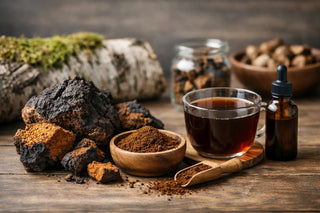
A dark, bark-like growth on birch trees is not the most obvious candidate for a premium wellness routine. Yet chaga has become one of the most talked-about functional mushrooms, prized for its long history of use and its dense concentration of naturally occurring compounds. When people ask about chaga mushroom benefits, they are usually asking two things at once - what traditional use suggests, and what modern evidence can reasonably support. For a broader view of how these ingredients are used, explore our guide to functional mushrooms.
That distinction matters. Chaga is an intriguing ingredient, but it is not a shortcut to better health. For a discerning wellness customer, the value lies in understanding where it may fit, what it contains, and how to approach it with sensible expectations.
What is chaga?
Chaga, or Inonotus obliquus, is a fungus that grows primarily on birch trees in colder climates, including parts of Northern Europe, Asia and North America. Rather than looking like a typical mushroom, it forms a blackened, irregular mass on the outside of the tree, with a rust-coloured interior.
Traditionally, chaga has been prepared as a decoction or tea and used in folk practices for general wellbeing. Today, it appears more often in powders, capsules, tinctures and drink blends. Its appeal comes from naturally occurring polysaccharides, polyphenols and other bioactive compounds, including betulin and betulinic acid derived in part from the birch tree on which it grows.
Chaga mushroom benefits: what people are looking for
Interest in chaga mushroom benefits is often centred on antioxidant support, immune function and everyday resilience.
Chaga is particularly rich in antioxidant compounds. Antioxidants help protect cells from oxidative stress, a process linked with normal ageing and a wide range of health concerns. This does not mean chaga prevents disease, but it helps explain its position within modern wellbeing routines. Ingredients with this profile are often included alongside antioxidant supplements within a lifestyle focused on diet, sleep and stress management.
Immune support is another common area of interest. Some early research suggests that compounds in medicinal mushrooms may influence immune activity, particularly certain polysaccharides such as beta-glucans. Immune health is complex, and any ingredient is best viewed as supportive rather than decisive.
There is also growing interest in chaga as part of a broader adaptogenic conversation. While the term is more often applied to herbs, chaga attracts those looking for steady, non-stimulating support. It is commonly used by people exploring adaptogenic supplements or moving away from high-caffeine routines.
The evidence behind chaga mushroom benefits
The science around chaga is promising, but still emerging. Much of the research has been conducted in laboratories or in animal models. These studies can demonstrate biological activity, but they do not confirm equivalent outcomes in humans.
Research has explored antioxidant properties, immune-modulating potential and inflammation pathways. These are scientifically relevant areas, but there remains a gap between laboratory findings and clinically meaningful effects in daily use.
The most balanced view is that chaga may complement a considered wellness approach, particularly for those interested in traditional botanicals, but expectations should remain measured.
Potential wellness uses in everyday routines
In a modern setting, chaga is typically used for general wellbeing rather than a single targeted benefit. Some people incorporate it into morning routines as a lower-caffeine alternative, while others use it seasonally when immune health is more front of mind.
It also appeals within a beauty-from-within approach due to its antioxidant profile. While this has intuitive appeal, it sits alongside more established factors such as skincare, UV protection, nutrition and sleep.
Chaga may also suit those drawn to ingredient-led, heritage-backed products. Its appeal is partly functional, but also experiential, fitting comfortably into routines that prioritise quality and provenance.
Who might consider chaga?
Chaga may appeal to adults looking to expand their supplement routine with functional mushrooms, particularly when a strong foundation is already in place. That foundation usually includes balanced nutrition, appropriate supplementation, exercise, sleep and stress management.
It is often of interest to those who prefer traditional ingredients presented in a more refined format. In that context, chaga stands out for its distinctive profile rather than broad claims.
When caution matters
Chaga contains biologically active compounds, which means care is appropriate in certain situations.
People taking blood-thinning medication should be cautious, as chaga may influence clotting. Those managing blood sugar levels should seek advice before use. If you have an autoimmune condition, are pregnant or breastfeeding, or are preparing for surgery, professional guidance is recommended.
There is also discussion around chaga's oxalate content with prolonged high intake. For those with kidney concerns, this is particularly relevant. Dose, frequency and product format all warrant attention.
Choosing a quality chaga product
Not all functional mushroom products are equivalent. The way chaga is sourced, processed and extracted can influence consistency and quality.
Look for products that clearly state the form used, such as powder, extract or dual extract. Extraction is significant, as different compounds are obtained through water or alcohol processes. Dual extraction is often used to provide a broader profile.
It is also worth checking sourcing transparency and any testing standards. For a premium customer, formulation quality should be a clear priority.
How to take chaga sensibly
If you are new to chaga, begin with a modest approach and follow product guidance. Capsules offer consistency, while powders and drink blends may suit those who prefer a more ritual-based format.
Timing is flexible and depends on personal preference. Consistency is generally more useful than occasional high intake, and introducing one supplement at a time makes it easier to assess suitability.
A balanced view of chaga mushroom benefits
Chaga is a traditional fungus with a compelling antioxidant profile and growing scientific interest. It may have a place within a well-considered wellness routine, particularly for those interested in functional ingredients with heritage.
At the same time, evidence in humans remains limited, and quality varies between products. A measured approach, grounded in realistic expectations and good product selection, is the most sensible way to engage with this mushroom.