
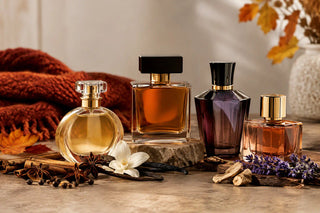
The Fragrance Families Dominating Autumn and Winter
A wool coat can change the way a fragrance feels. Cooler air, heavier fabrics and the move between crisp mornings and warm interiors all create a different setting for perfume.
That does not mean summer fragrances have to disappear until spring. A bright citrus can be wonderfully striking on a cold day, just as a very rich amber can feel overwhelming on a crowded train. But autumn and winter naturally invite us to explore fragrance with a little more texture: woods, amber, spice, leather, vanilla and deeper florals all seem to find their moment.
Fragrance families are useful starting points rather than rigid definitions, and many of the most interesting perfumes live somewhere between them. Amber can drift towards woods or spice, florals gain depth from musk, leather or patchouli, while gourmand notes can become considerably drier alongside woods or tobacco. It is often these overlaps that give a fragrance its character.
The colder months are a particularly enjoyable time to explore those relationships.
Why fragrance preferences often shift with the seasons
Warm weather naturally makes freshness appealing. Citrus, green leaves, aromatic herbs, aquatic notes and transparent florals can feel particularly comfortable against bare skin and heat.
Once temperatures fall, many people begin reaching for woody fragrances, amber fragrances, gourmand styles, spice, tobacco and leather. These families have enough warmth, texture or depth to sit naturally alongside heavier fabrics, colder air and darker evenings.
This is preference, not prescription. A crisp citrus can still be wonderfully striking in November, just as a particularly rich amber may feel too much on a crowded commute.
Season can simply provide an excuse to explore another part of your fragrance wardrobe.
If the terminology is unfamiliar, our guide to choosing fragrance by scent family explains how the major families relate to one another and can make exploring perfume considerably easier.
Amber: warmth in many forms
Amber fragrances feel particularly at home in autumn and winter, but amber is much broader than the dark, sweet perfume the name can sometimes suggest.
In modern perfumery, amber is an accord rather than the scent of fossilised amber itself. Resins, labdanum, benzoin, vanilla, balsams, spices and woods can all contribute to its characteristic warmth.
The interesting part is what happens around that structure.
A Soft Amber can be gentle, spicy and enveloping. Woody Amber moves towards woods, spice and resin. Spicier interpretations can feel deeper and more opulent, while floral or aromatic elements can introduce brightness.
Vanilla within amber fragrances is particularly interesting because the surrounding composition can completely change its character. In one fragrance it may feel creamy and sweet; surrounded by smoke, woods or resins, it can become considerably darker.
Our deeper exploration of the world of amber fragrance looks more closely at how the family is constructed.
For anyone who likes warmth but worries that amber will automatically become sugary or heavy, autumn is a very good time to discover just how varied the family can be.
Woody fragrances: from polished cedar to smoky depths
The woody fragrance family is an obvious cold-weather favourite, but it deserves better than simply being described as warm and earthy.
Cedar can feel clean, dry and architectural. Sandalwood brings a smoother, creamier character, while vetiver can move between grassy, earthy, mineral and smoky impressions.
The real interest lies in the subfamilies.
Woody aromatic fragrances combine the structure of woods with fresher herbs, spices and aromatic notes. Mossy Woods, traditionally associated with the chypre structure, introduce citrus, patchouli, vetiver and mossy effects. Dry Woods move towards smoke, leather and resin.
Then there is Woody Amber, where woods meet the softer, warmer pull of amber.
That range makes woody fragrance especially useful for somebody who wants a perfume with autumnal depth but does not necessarily enjoy sweetness.
Our guide to woody fragrances explores the family in more detail, while dry woods fragrances take the darker side of the family further.
Spice: warmth without necessarily becoming sweet
Spice is less useful as a single rigid family than as a character that can move through several parts of the fragrance map.
Cardamom can feel cool and aromatic. Black pepper gives a dry, brisk lift. Pink pepper can brighten florals. Ginger works particularly well alongside citrus and tea, while cinnamon, clove and nutmeg take fragrance towards a warmer, more recognisably autumnal direction.
Within our fragrance structure, spice appears particularly naturally through Amber and Fougère compositions rather than needing every spicy perfume to be separated from its wider family.
The most interesting spiced fragrances often retain some air around them. Citrus, flowers, herbs or dry woods prevent warmth from becoming weighty.
A peppery floral can feel remarkably polished. Cardamom over sandalwood has a very different character from cinnamon beside vanilla. The presence of spice tells you less about a fragrance than the company it keeps.
Gourmand: sweetness with more depth
Gourmand fragrances have an obvious affinity with autumn and winter. Vanilla, cacao, coffee, caramel, praline, almond and toasted notes echo many of the flavours and rituals associated with colder weather, but sweetness is only part of what defines the family.
The most interesting gourmands often rely on contrast. Vanilla can feel creamy and comforting in one composition, then considerably darker when surrounded by woods, leather, tobacco, smoke or resin. Coffee and cacao gain depth beside patchouli and dry woods, while salt, spice or florals can break through sweetness and give the fragrance more lift.
That contrast is what makes modern gourmand fragrance so varied. Some compositions are deliberately rich and indulgent; others use recognisably edible notes almost as a texture, softened by musk, sharpened by woods or drawn into warmer amber territory.
The family also overlaps naturally with the rest of the fragrance map. A gourmand can move towards amber through vanilla, tonka and resin, towards woods through sandalwood or cedar, or into darker territory through tobacco, leather and smoke. The result can still feel distinctly gourmand without smelling remotely like a patisserie.
Our guide to gourmand fragrance explores the family and its different expressions in more detail.
For anyone who has previously dismissed gourmand fragrance as simply too sweet, autumn and winter are a good time to discover how dry, woody, smoky or restrained the family can become.
Leather: a small family with plenty of character
Leather fragrances occupy a smaller corner of the fragrance world, but they are among its most distinctive.
Leather in perfume is rarely one literal smell. It can suggest polished leather, soft suede, smoke, saddlery or something darker and more animalic, giving the family a wonderfully tactile quality.
What surrounds the leather can change its character completely. Iris can make it feel smooth and elegant, saffron adds warmth, and rose creates an unexpectedly sensual contrast. Woods and smoke can take it somewhere darker, while softer florals can bring out the almost velvety quality of suede.
That makes leather particularly interesting in cooler weather. It sits naturally alongside the textures of the season: wool, suede, polished shoes, coats and gloves. There is warmth to it, but also a little attitude.
Perhaps that is part of leather's enduring appeal. It can feel elegant, provocative, restrained or thoroughly seductive depending on the composition and the person wearing it.
The family may be small, but it certainly does not lack personality.
Fougère: the classic structure worth rediscovering
Fougère is one of perfumery's classic structures, traditionally built around lavender, coumarin and mossy or woody notes. Fougère fragrances can feel aromatic, green and clean, but there is usually enough depth underneath that freshness to make the family particularly appealing as the weather cools.
The style has historically been closely associated with men's perfumery, although that says more about decades of fragrance marketing than it does about the structure itself. Lavender, herbs, woods and moss do not acquire a gender when they are combined in a bottle.
What makes fougère particularly useful in autumn and winter is how easily its balance can shift. Keeping the aromatic side prominent gives the fragrance a fresher, more herbal character, while adding spice, warmer woods or amber can make the same basic structure feel deeper and more enveloping.
That makes fougère an interesting alternative for anyone who wants more substance in colder weather without moving fully into rich amber, woody or gourmand territory. It retains freshness, but gives it a little more structure for the season.
Chypre and mossy woods: perfume with structure
The chypre idea sits naturally within the Mossy Woods branch of the fragrance map.
Traditionally, chypre fragrances contrast a bright citrus opening with a dry, mossy and woody base. Modern versions may rely on patchouli, vetiver, labdanum and contemporary moss effects, but the essential appeal remains the contrast between brightness and depth.
This is a family that rewards patience.
The first few minutes can feel crisp or even slightly austere. Given time, the structure underneath begins to show itself.
Patchouli is particularly interesting in these compositions because it can move from earthy and dark to polished, woody or almost chocolate-like depending on the materials around it.
Mossy Woods are ideal for somebody who likes fragrance to unfold gradually rather than announce everything in the opening spray.
Florals become richer when the temperature falls
Floral fragrances do not disappear when summer ends. If anything, cooler weather shows just how much range the family has.
The flowers can remain the heart of the fragrance while everything around them becomes warmer, darker or more textured. Rose takes on a velvety quality beside patchouli, woods, incense or spice. Jasmine can feel deeper and more opulent with amber, while tuberose is perfectly at home in richer, creamier compositions.
Iris brings something different again. Its cool, powdery character sits beautifully against cedar, sandalwood, musk and leather, creating fragrances that can feel elegant and substantial without becoming particularly sweet.
The floral family itself moves in several directions. Soliflore keeps a single flower firmly in focus, while Floral Bouquet allows several blooms to share the composition. Soft Floral moves towards gentler, more powdery territory, while Floral Amber takes flowers into a warmer, more enveloping part of the fragrance map.
That ability to borrow from neighbouring families is what makes floral fragrance so easy to carry through the seasons. A composition can retain an unmistakably floral identity while becoming woody, musky, spicy or ambered around the edges.
Rather than asking whether florals belong in autumn and winter, the more interesting question is what happens when the flowers are given a different supporting cast.
Fruity fragrances have an autumn side too
Fruity fragrances are easily associated with brightness and summer, but fruit changes dramatically once it is paired with warmer materials.
Fig beside woods feels very different from a sparkling citrus-and-fruit composition. Dark berries can become richer alongside amber, while plum, blackcurrant and other deeper fruit effects sit naturally with spice, patchouli and woods.
That makes Fruity another useful family for anyone who wants seasonal change without abandoning freshness entirely.
It also provides an accessible bridge into layering, because fruit can lift heavier perfume families without necessarily competing with them.
Our guide to the art of fragrance layering explores how families and notes can be combined to change the character of fragrances you already own.
Fresh fragrance can be particularly striking in winter
There is no reason the Fresh fragrance family should be packed away with summer clothes.
Citrus, green, aquatic and aromatic fragrances can provide a wonderful contrast to cold weather.
A crisp citrus fragrance on a bright November morning can feel cleaner and sharper precisely because it is unexpected. Green and aromatic styles work particularly well for anyone who finds conventional winter fragrance too enveloping.
Fresh fragrance can also be used to lighten a heavier scent through layering, or simply worn alone when amber, spice and vanilla feel like too much.
Seasonal fragrance should expand the wardrobe, not reduce it.
How to choose a fragrance for colder weather
Begin with the atmosphere you enjoy rather than a list of notes you believe you should wear.
If you want something polished for everyday use, woods, aromatic fougères, iris, musk or a restrained amber can all work beautifully.
For evenings, you may want to explore warmer amber, leather, dry woods, spice or gourmand compositions.
Concentration matters too. An eau de parfum can have more presence than a lighter concentration, but perfume strength still varies enormously between individual compositions. A powerful fragrance may need very little application in a warm restaurant or crowded train.
Whenever possible, test perfume on the skin and give it time.
The opening is only an introduction. The heart and base are where many autumn and winter fragrances become most interesting.
If you are looking for something that could become part of your everyday identity rather than simply a seasonal choice, our guide to finding a signature fragrance looks at how personal preference, fragrance family and wearability come together.
Let winter expand your fragrance wardrobe
The colder months do not belong exclusively to amber, woods and vanilla.
They simply provide a different setting in which to experience perfume.
Leather can feel smoother. Gourmand fragrance can become darker. Florals gain warmth from amber and woods. Fruit can move towards spice and patchouli, while a crisp citrus can feel even brighter against cold air.
That is the pleasure of thinking in fragrance families rather than rigid seasonal rules.
The map provides somewhere to begin.
Your nose decides where you go next.