
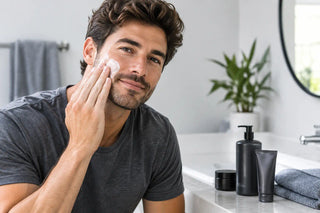
Men’s Skincare Without the Complicated Routine
The bathroom shelf does not need to resemble a laboratory for your skin to look comfortable and well cared for. Men’s skincare without the complicated routine starts with three things that have straightforward jobs: something suitable to wash your face with, something to stop it feeling dry and something to protect it from the sun.
That is essentially it.
There are plenty of serums, retinoids, acids, eye creams and other products worth exploring if you have a particular reason to use them. You do not need to begin there. A good routine is one you will actually follow, and for many men that means keeping it short.
What's wrong with using body soap on your face?
Possibly nothing, if your face genuinely feels comfortable afterwards. But there is a reason facial cleansers exist beyond finding another bottle to sell you.
Soap and body wash are principally designed to clean the body. Depending on the formula, that can mean more cleansing power than your face actually needs, particularly if you shave regularly as well. If washing your face with whatever happens to be in the shower leaves it feeling tight, dry or slightly uncomfortable, that isn't evidence that it has done an especially thorough job. It is a good indication that something gentler might suit your face better.
A facial cleanser has a fairly unglamorous job: remove sweat, excess oil, sunscreen and the day's grime without making your skin feel as though it has been pressure-washed.
You don't need three cleansers. You don't necessarily need separate morning and evening versions. And you certainly don't need to become interested in the finer points of double cleansing unless you want to.
Start with one of the cleansers designed for men's skin that suits how your face actually feels. If your skin tends to be dry, a cream or low-foam formula may be more comfortable. If it is oilier, a light gel or gentle foaming cleanser may suit you better.
For many people, cleansing properly in the evening is the important part because it removes sunscreen, sweat and everything accumulated during the day. In the morning, particularly if your skin tends to be dry, a rinse with lukewarm water may be perfectly adequate.
If the bar of soap you have used for twenty years leaves your face completely comfortable, nobody is going to confiscate it. But if your skin feels tight every time you step out of the shower, the soap is an obvious thing to question.
Yes, moisturiser is worth bothering with
Moisturiser still has an image problem among some men. Cleanser sounds practical. Sunscreen has an obvious job. Moisturiser can somehow sound like an optional beauty product, particularly if your mental picture involves floral fragrances, elaborate jars and a bathroom shelf belonging to somebody else.
Forget that picture.
Moisturiser has a straightforward purpose. It helps reduce water loss from the skin and supports the skin barrier, which in turn helps keep skin comfortable. Washing, shaving, cold weather, central heating and simply getting through the day can all contribute to skin feeling tighter or drier.
Nor does moisturiser have to smell of flowers. Today's moisturisers for men include different textures for different preferences, so there is no reason to put up with something that feels too heavy for your face. If the idea of a rich cream sitting on your skin all morning has put you off moisturiser, choose a lighter texture instead.
Oily skin does not automatically get a free pass either. Moisturising your skin and making it greasy are not the same thing. A lightweight moisturiser can provide hydration without leaving the face feeling coated or shiny.
And if you shave, there is an even more obvious reason to consider it. A razor repeatedly passes over the surface of your face while removing hair. If your skin feels tight or uncomfortable afterwards, moisturising is a practical response rather than an indulgence.
You don't need separate day and night creams simply because somebody has designed matching jars. Start with one moisturiser that feels good enough that you will actually use it.
That is the entire trick.
SPF? In Britain?
Yes.
A grey British morning may not feel much like sunscreen weather, but ultraviolet radiation does not disappear simply because the sky has returned to its familiar shade of filing cabinet.
Daily broad-spectrum sun protection is worthwhile for exposed skin, particularly the face, ears, neck and scalp where relevant. An SPF 30 or higher gives you a straightforward starting point for everyday use, alongside sensible measures such as seeking shade and wearing appropriate clothing when exposure is stronger or prolonged.
The important practical question is not whether you can find the most sophisticated sunscreen in existence. It is whether you can find one you are willing to put on.
If you dislike heavy or shiny sunscreens, the range of sun protection specifically suited to the face includes fluid, gel and lightweight cream textures. A facial SPF does not need to feel like the thick white sunscreen you remember from childhood holidays.
A moisturiser containing SPF can be convenient for ordinary mornings. When you are going to spend longer outside, applying a dedicated sunscreen can make getting adequate coverage easier. Reapplication becomes more important during prolonged outdoor exposure and after swimming, heavy sweating or towel drying.
Britain may not provide dependable sunshine. Unfortunately, that is not the same thing as not having ultraviolet radiation.
So the basic routine really is this simple
In the morning:
Rinse or cleanse if needed → moisturise if your skin needs it → SPF.
In the evening:
Cleanse → moisturise.
That's a skincare routine.
You do not need lengthy pauses between stages. You do not need to apply products with special choreography. You do not need a separate drawer.
What matters much more is whether the products suit your skin and whether you use them consistently.
What about shaving?
Shaving complicates men's skincare slightly because it puts a blade directly across the skin, but the answer is not necessarily to add more skincare.
Warm water and a suitable shaving cream, gel or soap can help prepare the beard and provide slip for the razor. Afterwards, skin that feels tight or dry may simply benefit from the moisturiser you already own.
If shaving repeatedly leaves your neck red or uncomfortable, look at the shave itself before buying another serum. Blade condition, pressure, repeated passes and the direction of hair growth may be more relevant than what is sitting on the bathroom shelf. Our guide to the return of the proper shave goes into the preparation, razor choice, technique and aftercare in more detail.
Persistent razor bumps, broken skin or substantial irritation deserve a more considered approach rather than aggressive scrubbing or repeatedly trying new products.
Dry skin? Oily skin? Keep the principle the same
Skin type changes the products more than it changes the routine.
If your face feels dry or tight, favour a gentle cleanser and a slightly richer moisturiser. Lukewarm water is preferable to enthusiastically hot water, and rubbing the face dry with a towel is unnecessary.
If your skin tends to be oily, you still do not need to declare war on it. A light gel cleanser and a lightweight moisturiser may be all that is required. Scrubbing harder, washing repeatedly or choosing the harshest cleanser available can leave skin uncomfortable without solving the underlying problem.
Combination skin does not necessarily demand a complicated routine either. A lightweight moisturiser across the face may work perfectly well, or you may find that drier areas appreciate slightly more product.
The test is how your skin actually behaves, not which category somebody has told you that you belong to.
Do I need serums, retinol and all the other stuff?
No.
Not unless you have a reason to want them.
Once cleansing, moisturising and sun protection are working comfortably, you may decide there is something specific you would like to address. Perhaps uneven tone bothers you, or you would like to improve the appearance of texture or fine lines. That is when a targeted product can make sense.
The emphasis is on a targeted product.
Skincare tends to become complicated when several products are bought for several different concerns at once. Suddenly the straightforward routine has acquired an acid, a retinoid, vitamin C, niacinamide and something containing peptides, while nobody remembers which product was originally meant to solve which problem.
If you want to introduce an active product, decide what you actually want it to do, choose accordingly and introduce it gradually. There is little advantage in adding several new formulas at once, particularly if your skin is not accustomed to them.
You can always become more interested in skincare later. Complexity is available whenever you want it. It does not need to be the entry price.
How to choose products without getting lost
Ignore the number of steps in somebody else's routine and concentrate on how a product fits into yours.
For a cleanser, ask whether your skin feels comfortable after washing.
For a moisturiser, ask whether you like the way it feels enough to use it every day.
For sunscreen, ask whether you will willingly put it on in the morning.
Those are surprisingly useful filters.
Price does not change the principle. A premium product should earn its place through formulation, texture, experience or suitability, rather than simply giving you more things to apply. Three well-chosen products that get used consistently are considerably more useful than ten expensive bottles gathering dust.
If you try something new and your skin tends to be sensitive or reactive, test it cautiously rather than immediately using it across your whole face. Introduce products individually so that if something does cause irritation, you have a reasonable chance of knowing what did it.
Persistent, painful or otherwise concerning skin problems are different from simply choosing a skincare routine. If something does not settle or you are concerned about a change in your skin, ask a pharmacist, GP or dermatologist for appropriate advice.
Skincare does not need to become a hobby
You can become fascinated by skincare if you want to. There is an enormous world of ingredients, formulations and routines to explore.
You are equally entitled not to care about it. Use a moisturiser that keeps it comfortable. Protect exposed skin from the sun. If you later identify something specific you want to change, consider one appropriate addition.
That is men's skincare without the complicated routine.
And it fits on a very small bathroom shelf.