
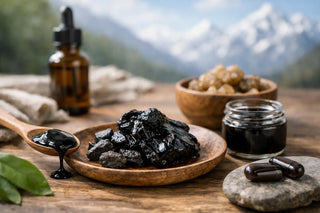
A jar of dark, glossy resin may look straightforward, yet shilajit is one of the supplement categories where provenance matters as much as the ingredient itself. Shilajit - what it is and how to choose - is therefore not simply a question of finding the highest figure on a label. It is about understanding the source, the level of testing and whether the product is appropriate for you.
What is shilajit?
Few supplements have an origin as striking as shilajit. It is a dark, tar-like resin that seeps from cracks in rock faces high in mountain ranges such as the Himalayas, Altai and Caucasus, appearing on the stone as the weather warms. It forms over centuries, as layers of plant and microbial matter are slowly compressed and transformed, taking up minerals from the surrounding rock as it goes. What reaches a supplement shelf is the purified end point of a very long natural process - which is precisely why where it comes from, and how it is cleaned up, matters so much.
Traditional Ayurvedic practice has used purified shilajit for centuries, where it held an esteemed place and was prepared with considerable care. That long history is part of the appeal today, though it is worth being clear that traditional use is not the same as proven modern benefit. Contemporary supplements present it as a resin, powder, capsule or liquid extract. Its characteristically deep brown to near-black colour, earthy aroma and bitter, mineral taste are all familiar features of the raw material, although they are not proof of quality in themselves.
Shilajit contains a complex mixture of compounds. Fulvic acids are among the most frequently discussed, alongside humic substances, trace minerals and other naturally occurring plant-derived constituents. The precise composition can vary considerably according to geography, harvesting conditions and the purification process. This variability is the central consideration when choosing a product.
Shilajit is commonly marketed for energy, vitality and general wellbeing, although evidence supporting these uses varies considerably between products and remains limited.
Why quality and purification are non-negotiable
Raw shilajit is not automatically suitable for consumption. Because it is collected from mineral-rich rock, unprocessed material may contain undesirable contaminants, including heavy metals, microbial contaminants or excessive mineral levels. Responsible manufacturers purify and test their shilajit before it is used in a supplement.
That does not mean every product described as 'pure', 'natural' or 'Himalayan' offers the same assurance. These are marketing terms unless they are supported by clear information about sourcing, processing and independent testing. A premium supplement should make it easier to understand what is in the jar or capsule, rather than relying on dramatic origin stories alone.
Look first for a manufacturer that identifies the ingredient as purified shilajit or a standardised shilajit extract. Ideally, it should explain the source region, batch testing and the controls used for contaminants. Some brands provide a certificate of analysis for a batch, which may show results for heavy metals and microbiological quality. This is particularly valuable for a naturally variable ingredient.
Be cautious with products that make sweeping promises or offer no meaningful detail beyond a photograph of mountains. A very low price can also warrant a closer look, especially for resin products where careful purification, laboratory analysis and responsible sourcing contribute to the final cost.
Fulvic acid: useful context, not the whole story
Many labels highlight a percentage of fulvic acid. This can be helpful because it gives a point of comparison between standardised extracts, but it should not be treated as a universal quality score. Testing methods differ, and a high stated percentage says little on its own about purity, traceability or whether a product has been screened for contaminants.
A sensible approach is to view fulvic acid alongside the whole specification. Is the serving size clear? Does the brand state whether the figure relates to the finished product or the shilajit ingredient? Has the product been tested for contaminants? Is the retailer able to provide reliable product information? A measured, transparent answer to these questions is more useful than an impressive percentage in isolation.
Choosing a shilajit format
The best format depends on how you prefer to take supplements and how much control you want over each serving. Resin is closest to the traditional presentation - the format shilajit has taken for centuries. It is usually dissolved in warm water, milk or another warm drink, and lets you adjust the amount gradually. It has a distinctive earthy, bitter flavour and takes a little more care to measure. A Pure Himalayan Shilajit resin, available in 50g and 100g, or a resin paste such as TruHerb's, suits those who want the traditional experience and are comfortable with the taste.
Capsules are often the most practical choice for busy routines. They provide a pre-measured serving, travel easily and avoid the strong taste of resin - Fushi and TruHerb both offer capsule forms. Check whether the capsule contains purified shilajit resin, an extract standardised to particular compounds, or a blend with other ingredients; the label should make this clear. Neither format is inherently superior. It is a question of how you prefer to take it and how much you value the traditional ritual of dissolving resin yourself.
Powders and liquids can suit those who prefer to add supplements to a daily drink, though accuracy and flavour are worth considering. Whichever form you select, follow the suggested daily serving on the packaging. More is not necessarily better, particularly with ingredients that have a naturally complex mineral profile.
How the brands differ
The shilajit products available broadly fall into two categories, and the distinction is genuinely useful when choosing.
The first is single-ingredient shilajit - nothing but the purified resin. Pure Himalayan takes this approach, offering 100% shilajit sourced from the Himalayas as a resin, in 50g and 100g jars.
TruHerb gives you a choice of format: a sun-dried paste for those who want the traditional resin experience, or capsules providing 500mg of pure shilajit powder each for convenience. If your priority is knowing that what you take is shilajit and nothing else, these are the straightforward choices, and TruHerb's capsule is a gentler entry point on price.
The second camp is formulated blends. Fushi's capsules are the example here: rather than shilajit alone, they combine a shilajit extract standardised to at least 20% fulvic acid with three traditional Ayurvedic botanicals - Tulsi (holy basil), Kapikachhu (Mucuna pruriens) and White Musli. A standardised extract means the fulvic acid content is specified rather than left to vary, which some people value; the added botanicals reflect how shilajit is often combined in traditional formulas. It is worth knowing that these companion herbs are included on the basis of traditional use rather than authorised health claims, and a blend makes it harder to judge exactly how much shilajit you are taking - some people may prefer to start with a single-ingredient product because it can make it easier to understand exactly what they are taking.
A practical checklist for selecting shilajit
This is where a considered purchase pays off. When comparing shilajit products, assess the full proposition rather than being led by one headline. The following details are worthwhile:
- Purified shilajit or a clearly named, standardised extract
- A stated source and responsible manufacturing information
- Batch or third-party testing for heavy metals and microbiological contaminants
- A transparent ingredient list, serving size and directions for use
- Storage instructions and a batch number, particularly for resin and liquid formats
Also consider unnecessary additions. Flavourings, sweeteners and botanical blends may be welcome if they serve a clear purpose, but they can make it harder to judge how much shilajit you are actually taking. For first-time users, a single-ingredient product with a clear specification is often the most straightforward place to start.
Using shilajit thoughtfully
Food supplements are intended to complement, rather than replace, a balanced diet and healthy lifestyle. Although shilajit has a long history of traditional use, high-quality clinical evidence supporting many of the health claims made for commercial products remains limited. Research findings for one shilajit extract cannot automatically be applied to all shilajit products because formulations and manufacturing processes vary.
Be wary of products that present it as a treatment for medical conditions, an instant answer to fatigue or a substitute for sleep, nutrition and professional healthcare.
If you decide to try it, begin with the label-recommended amount rather than exceeding it. Pay attention to how you feel, particularly if you are new to supplements with concentrated botanical or mineral ingredients. A product that causes persistent digestive discomfort or any unexpected reaction is not one to continue without advice.
When to seek professional advice
Shilajit is not suitable for everyone. Those who are pregnant, trying to conceive or breastfeeding should avoid it unless a healthcare professional specifically advises otherwise, as safety data are limited. The potential for interactions with medicines has not been comprehensively studied, which is one reason professional advice is recommended before combining shilajit with prescribed treatments. Speak to a pharmacist, GP or qualified healthcare professional before use if you have a medical condition, take regular medicines or have been advised to monitor iron or mineral intake.
This is especially relevant for people with kidney disease, a history of gout, haemochromatosis (a condition causing excess iron accumulation) or other conditions affected by mineral balance. Anyone taking medicines for blood glucose, blood pressure or other long-term health concerns should seek individual guidance rather than assuming that a natural product cannot interact with their treatment.
Because shilajit products vary considerably in quality, authenticity and composition, purchasing from reputable retailers and established manufacturers is particularly important. For a curated supplement choice, the most persuasive sign is not theatrical packaging or a dramatic claim. It is a product that is specific about its origin, honest about its contents and supported by testing you can understand. Choose that level of care, then give the supplement the same measured consideration you would any part of a well-designed wellbeing routine.