
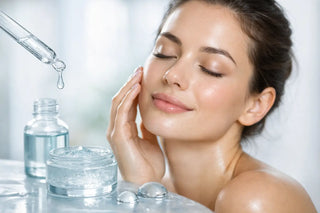
A serum can feel elegant on the skin, but texture alone is not the point. When customers ask what does hyaluronic acid do, they are usually asking a more practical question - will it make skin feel better, look fresher and behave as though it is properly cared for?
If you have already explored our guide to active skincare ingredients, you will know that not every ingredient is designed to transform the skin in dramatic ways. Some play a quieter but essential role.
Hyaluronic acid sits firmly in that category. It does not exfoliate, brighten or resurface. Instead, it supports something more fundamental - hydration. And without proper hydration, even the most advanced routines struggle to perform at their best.
In many cases, yes, hyaluronic acid will make skin feel more comfortable and look more refined. But its role is often oversimplified. Understanding how it works - and how it fits alongside other actives - is what makes it genuinely useful. (For a practical guide to combining ingredients, see our guide to layering active skincare.)
What does hyaluronic acid do in skincare?
Hyaluronic acid is a humectant, which means it attracts water. It is found naturally in the body, including the skin, where it helps maintain hydration and suppleness. In topical skincare, its main job is to support moisture levels at the skin’s surface so the complexion feels more comfortable and appears more refined.
That can translate into several visible and sensory benefits. Skin may feel less tight after cleansing, makeup may sit more evenly, and the surface can look smoother because dehydration is less pronounced. On a well-formulated level, hyaluronic acid can also support the skin barrier indirectly by helping maintain the moisture balance that healthy skin prefers.
This is where nuance matters. Hyaluronic acid is not the same as a rich moisturiser, and it is not a substitute for barrier-supporting lipids such as ceramides or nourishing emollients. Think of it as part of a hydration strategy rather than the entire strategy.
Why skin responds so well to hyaluronic acid
Hydration changes how skin looks almost immediately. When skin lacks water, it can appear dull, feel rough and show temporary fine lines that are more about dryness than age. Hyaluronic acid helps address that by drawing moisture to the upper layers of the skin.
The result is often a fresher-looking complexion with a softer feel. This is one reason the ingredient is so widely used across premium skincare, from lightweight essences to concentrated serums and richer creams. It is versatile, generally well tolerated and suitable for many skin types, including sensitive and blemish-prone skin.
That said, suitability depends on the full formula. A hyaluronic acid serum with added fragrance or a high level of alcohol may not suit reactive skin, even if hyaluronic acid itself is unlikely to be the problem. Product quality, supporting ingredients and skin context all matter.
What does hyaluronic acid do for different skin concerns?
For dry or dehydrated skin, hyaluronic acid helps replenish surface hydration and reduce that uncomfortable, stretched feeling. It can make the skin feel more resilient, especially when layered beneath a cream that helps seal in moisture.
For oily or combination skin, it offers hydration without the weight some richer products can bring. This is useful because oily skin can still be dehydrated, particularly after over-cleansing or active treatments aimed at spots and congestion.
For mature skin, the benefit is usually in comfort and appearance rather than structural transformation. Hyaluronic acid can soften the look of fine lines caused by dehydration and give the skin a fuller, smoother finish. It will not replace ingredients chosen for firmness or pigmentation, but it pairs well with them.
For sensitive skin, a simple hyaluronic acid formula can be a sensible way to support hydration without adding unnecessary complexity. As ever, minimal and well-formulated tends to be better than complicated and highly fragranced.
How hyaluronic acid works best in a routine
The ingredient tends to perform well when applied to slightly damp skin, followed by a moisturiser. There is a practical reason for this. Humectants draw water, so giving them moisture to work with and then sealing that hydration in can improve the overall result.
A common mistake is applying a hyaluronic acid serum alone and stopping there, particularly in dry indoor environments or cold weather. If there is not enough ambient moisture and no cream layered on top, skin may still feel dry later. That does not mean the ingredient has failed. It usually means the routine is incomplete.
For most people, hyaluronic acid sits comfortably after cleansing and before moisturiser. It also layers well with many other ingredients, including niacinamide, vitamin C and retinoids. In fact, it is often useful alongside stronger actives because it helps reduce the feeling of dryness that some treatment products can bring.
This is also why hyaluronic acid is frequently used alongside more intensive actives. Where treatments such as retinoids or exfoliating acids can challenge the skin’s comfort, hydration-focused ingredients help maintain balance so results are achieved without unnecessary disruption.
Molecular weight, formulas and why not all products feel the same
Two hyaluronic acid serums can behave very differently. Part of that comes down to molecular weight, which affects how the ingredient sits on the skin. Higher molecular weight forms tend to remain closer to the surface, where they help with immediate hydration and a smooth feel. Lower molecular weight forms are often included to support hydration in a different way and can contribute to a more plumped appearance.
This is why many well-developed formulas use multiple forms of hyaluronic acid rather than a single version. The aim is not complexity for its own sake, but a more complete hydration profile and a more elegant finish.
Texture also matters. Some formulas feel almost watery and disappear quickly, which may suit layered routines or oilier skins. Others are more cushioned and substantial, which can appeal to drier complexions. The best choice is not always the highest concentration. It is the one your skin will use consistently and comfortably.
What hyaluronic acid does not do
For an ingredient this popular, expectations can become inflated. Hyaluronic acid does not exfoliate dead skin cells in the way alpha hydroxy acids do. It does not regulate oil production in the way niacinamide may. It does not stimulate collagen in the same category as retinoids, and it will not address pigmentation directly.
That does not make it basic or unremarkable. It makes it specific. In premium skincare, the most valuable ingredients are often those that know their role. Hyaluronic acid’s role is hydration support, and when hydration is improved, the skin often looks calmer, smoother and more polished.
There is also occasional confusion between topical hyaluronic acid and injectable hyaluronic acid fillers. They are not interchangeable. A serum hydrates the skin’s surface. Injectable treatments are medical aesthetic procedures with very different purposes and outcomes.
Who should use hyaluronic acid?
Most skin types can benefit from it, particularly if the skin feels dehydrated, tight, flaky or temporarily sensitised by weather, travel or active skincare. It is especially useful in routines that need more comfort without becoming heavier or greasier.
If your skin is already balanced and you prefer a very streamlined routine, you may not need a separate hyaluronic acid serum if your moisturiser already contains humectants. Equally, if your skin barrier is compromised, hyaluronic acid alone may not be enough. In that case, pairing it with ceramides, glycerin and a suitable moisturiser is often a better approach.
This is where curated product selection matters. At John Bell & Croyden, hydration is not treated as a trend category but as a skin need that can be met through different textures, strengths and supporting ingredients, depending on the individual.
How to choose a good hyaluronic acid product
Look beyond the front label. A good formula should fit your skin type and routine rather than simply promise dramatic results. If your skin is dry, consider hyaluronic acid in a serum or cream with barrier-supporting ingredients. If your skin is combination or blemish-prone, a lightweight serum may be sufficient under moisturiser.
It is also worth considering the rest of the formula. Glycerin, panthenol, ceramides and soothing ingredients can make a hydrating product more complete. Fragrance levels, essential oils and strong acids may matter if your skin is reactive.
Packaging and consistency play a part too. If a product pills under sunscreen or makeup, you are less likely to use it regularly. Efficacy matters, but so does elegance.
Hyaluronic acid earns its place in skincare because it does one job exceptionally well. When chosen thoughtfully and used with the right supporting products, it can make skin feel more comfortable, look more refined and hold up better to the pressures of modern routines, busy schedules and less-than-ideal environments. Sometimes that quiet reliability is exactly what skin needs most.
Hydration needs vary by skin type, which is why hyaluronic acid appears across a wide range of formulations rather than a single category.
If your skin feels dry or depleted, explore formulations designed to replenish and support the barrier in our dry skincare collection. For oilier or combination skin, lightweight hydration can help maintain balance without adding excess weight - see our oily skin range. And if your skin is easily unsettled, simpler hydrating formulas are often the most reliable starting point within our sensitive skincare selection.