
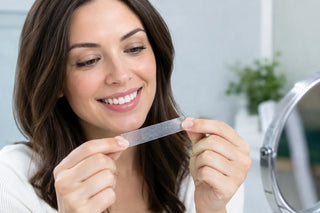
A brighter smile can feel like a small but meaningful refinement. But are whitening strips safe to use at home, particularly if you have sensitive teeth, restorations or a history of gum irritation?
For most adults with healthy teeth and gums, a strip bought from a UK retailer and used exactly as directed is a reasonable option. The more useful answer, though, begins somewhere most articles never go: with what UK law actually permits you to buy, because that single fact explains both why home whitening is gentle and why some of the results you see online are not achievable safely.
What UK law allows you to buy
Tooth whitening products are regulated by the concentration of hydrogen peroxide they contain or release, and the line is drawn sharply.
Retailers - including pharmacies - may only supply products containing or releasing 0.1% hydrogen peroxide or less. Products above that level and up to 6% may only be supplied to dental practitioners, with the first use of each course carried out or directly supervised by a dentist, for patients aged 18 or over. Anything releasing more than 6% has no legal route for cosmetic whitening in the UK at all. A retailer prosecuted for selling non-compliant products can be fined up to £20,000.
The gap between what you can buy and what a dentist can use is therefore substantial: a sixtyfold difference in permitted strength. This is not a technicality. It is the single most useful thing to understand before buying, because it sets a realistic expectation of what a home strip can do.
It also explains something that confuses a lot of people. Certain well-known American strip brands are not sold legally in the UK, not because strips are banned, but because their peroxide concentration exceeds the retail limit here. A product's legality depends on the hydrogen peroxide released, so a kit advertising a carbamide peroxide percentage is caught by the same rule.
Why imported strips are a genuine risk
Where there is a gap between expectation and what is legally available, a grey market follows. A BBC News investigation published in October 2025 had whitening products bought from unregistered sellers laboratory tested, and found hydrogen peroxide at up to 53% - roughly 500 times the limit for direct consumer sale, and around nine times the ceiling that applies even to a dentist.
At those concentrations the risk is not mild sensitivity. It is chemical burns to the gums and soft tissue, and damage to enamel and existing dental work. Buying outside the legal framework also voids the consumer protections that make a complaint or a claim possible.
The practical guidance is simple. Buy from a UK retailer, be wary of products with no clear ingredient percentages or UK seller information, and treat a price far below comparable products as a warning rather than a bargain.
How whitening strips work
Tooth colour is affected by more than surface staining from coffee, tea, red wine or smoking. Over time, pigments can become incorporated within the enamel and dentine. Whitening strips use peroxide to break down these coloured compounds, making teeth appear lighter.
The strip holds the gel against the front surface of the teeth for a prescribed period. Results vary according to the original shade of the teeth, the length of treatment and the nature of the discolouration. Yellow-toned staining often responds better than grey staining, which can be associated with certain medicines, trauma or changes within the tooth itself.
Because peroxide works through a chemical process, more is not necessarily better. Leaving strips on longer than directed, applying them repeatedly in pursuit of a faster result, or combining several whitening products at once increases the likelihood of sensitivity without producing a proportionately whiter smile. With a product at the legal retail concentration, patience matters more than intensity.

Sold in the UK
SPOTLIGHT ORAL CARETeeth Whitening System
Are whitening strips safe when used correctly?
For people with sound enamel, healthy gums and no untreated dental concerns, strips bought legitimately and used according to the instructions are generally considered safe. Check the directions carefully and complete only the recommended course.
Temporary tooth sensitivity is the most common side effect. You may notice a brief sharp sensation when drinking something cold, or a general sensitivity during the treatment period. This happens because peroxide can temporarily irritate the inner part of the tooth. It usually settles after treatment stops, though anyone already prone to sensitivity may find it more noticeable.
Some people also develop mild gum irritation, especially if the strip overlaps the gum line or the gel spreads beyond the teeth. This should not be ignored. Remove the strip, rinse your mouth gently and pause treatment until the area feels comfortable. Persistent soreness, swelling, white patches on the gums or pain that does not settle warrants advice from a dentist.
Strips do not usually damage enamel when used as instructed. The greater concern is misuse: frequent back-to-back courses, extended wear times, and mixing strips with strong whitening toothpastes, trays or rinses. Think of whitening as a measured treatment, not a daily maintenance habit.
Who should speak to a dentist first?
A dental check is the most considered starting point if you are unsure why your teeth have changed colour, or have not seen a dentist recently. Whitening will not treat decay, gum disease or an infection, and peroxide can make an existing problem more uncomfortable.
Seek professional advice before using strips if you have toothache, bleeding gums, exposed roots, enamel erosion, cracks, cavities, loose fillings or significant sensitivity. It is also sensible to ask for guidance if you wear braces or retainers, have recently had dental work, or are considering whitening during pregnancy or while breastfeeding. There is limited evidence in these circumstances, so clinicians commonly advise postponing non-essential whitening.
Children and teenagers should not use whitening products. Dentist-supervised whitening in the regulated concentration band is restricted to those aged 18 and over, and discolouration at a younger age may need investigation rather than a cosmetic solution.
What whitening strips cannot change
Strips act on natural tooth structure only. They will not lighten crowns, veneers, bonding, bridges, fillings or implants. If these restorations are visible when you smile, whitening the natural teeth around them may leave a noticeable difference in shade.
This does not mean whitening is off the table. A dentist may be able to plan whitening before replacement restorations are colour-matched, or recommend another route for a single dark tooth. The key is to avoid treating an uneven result as a reason to keep applying strips beyond the advised course.
It is also worth setting a realistic expectation. A healthy, natural-looking brightening is usually more flattering than an ultra-white shade that contrasts sharply with your complexion or existing dental work.
Using whitening strips with greater care
Read the full leaflet first, including the recommended wear time and frequency. Clean teeth help, but avoid brushing immediately before application if your gums are easily irritated. Wait a little while after brushing, then dry the front surfaces gently with a tissue if the instructions suggest it.
Apply each strip carefully, keeping it on the enamel rather than the gum line. Fold excess material behind the teeth only where directed. Avoid eating, drinking or smoking while the strips are in place, and wash your hands after handling the gel.
During a course, be thoughtful about habits that contribute to new staining. Tea, coffee, red wine, deeply coloured sauces and tobacco all affect the appearance of teeth. You do not need an impractical white-food diet, but rinsing with water after staining drinks and maintaining attentive brushing will help preserve the result.
If sensitivity develops, take a break rather than pushing through. Use a toothpaste formulated for sensitive teeth and a soft-bristled brush with a gentle technique. A short pause may be all that is needed. If sensitivity is severe, spontaneous, localised to one tooth or lasts beyond a few days after stopping, book a dental appointment.
When professional whitening is the better route
If you want a change of shade rather than a gentle lift, a dentist is not simply the safer option - legally, it is the only route to the concentrations that produce that result.
A dental assessment also does something a strip cannot: it establishes why your teeth have darkened. Professional cleaning alone removes surface deposits and sometimes produces a noticeable improvement before whitening is considered at all. Where whitening is appropriate, a dentist can account for sensitivity, existing restorations and the evenness of the result.
Between appointments, a considered routine does more for the appearance of your teeth than repeated cosmetic treatment: twice-daily brushing with fluoride toothpaste, daily interdental cleaning, and regular examinations. Our guide to premium dental care sets out the full routine, and our guide to whitening toothpastes covers everyday stain management.
A brighter smile should never come at the expense of comfort, and no cosmetic result is worth a burn or a damaged tooth. If your teeth and gums are healthy, use a legitimately purchased strip sparingly and precisely. If you want more than that, the answer is a dentist rather than a stronger product bought from an unfamiliar seller.