
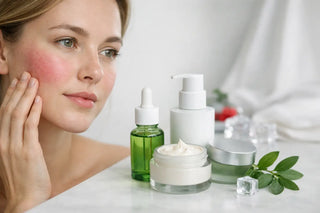
Redness rarely behaves like a single skincare concern. For some, it appears as a fleeting flush after heat, exercise or a glass of wine. For others, it is a more persistent background of sensitivity across the cheeks, nose or chin that can make even a well-formulated cleanser feel like too much. That is why any anti-redness skincare routine or review worth reading must go beyond marketing claims and focus on how formulas actually perform on reactive skin.
Anti redness skincare review: what matters most
Products designed for visible redness often promise immediate calm, but the better question is whether they reduce triggers, support the skin barrier, and remain comfortable over time. Redness-prone skin is frequently compromised skin. When the barrier is unsettled, water escapes more easily, irritants penetrate faster and the complexion becomes more reactive to ingredients that would otherwise be tolerated. If you are already using actives, this is often where imbalance begins, which is explored in more detail in our guide to active skincare ingredients.
In practical terms, the strongest anti-redness formulas tend to share three qualities. They minimise unnecessary stimulation, they reinforce barrier function, and they deliver soothing support without creating heaviness that feels occlusive or greasy.
Texture also deserves more attention than it usually gets. A rich cream can be excellent for dry, fragile skin, but less successful for someone whose redness sits alongside oiliness or blemishes.
Which ingredients genuinely help visible redness?
The most reliable anti-redness ingredients are not always the most fashionable. Niacinamide skincare remains one of the most useful because it supports the barrier, helps reduce water loss and can improve the appearance of uneven tone. For a broader context, the active skincare ingredients guide explains how it fits within a routine.
Panthenol, allantoin and glycerin are less glamorous on the label, yet often more meaningful in use. These ingredients support comfort and hydration, which can make redness look less pronounced simply because the skin is less stressed. Ceramide-rich moisturisers are similarly valuable, especially when redness is accompanied by dryness.
Colloidal oatmeal deserves mention for skin that feels itchy or easily unsettled. It can be particularly reassuring during periods of seasonal sensitivity. You can explore soothing skincare products that prioritise comfort and barrier support.
What tends to complicate matters is the presence of actives that may be useful in one context and irritating in another. Acids, retinoids and even vitamin C are not inherently unsuitable for redness-prone skin, but they require careful handling. A person managing dullness and fine lines may still benefit from them, yet not every evening and not always in the highest strength available. Redness asks for restraint. For those trying to introduce stronger ingredients more cautiously, retinol for sensitive skin outlines a more measured approach.
Ingredients to approach with caution
Fragrance is an obvious consideration, though not every fragranced product will cause a problem.
Physical exfoliants are another common misstep. If your skin is visibly red, hot or easily irritated, a gritty scrub is rarely the answer. Even some cleansing brushes can be too much. Gentle cleansing and controlled leave-on treatment usually serve the skin better than aggressive polishing. Choosing from gentle face cleansers is often a better starting point, particularly if your skin behaves unpredictably or shows signs of rosacea, where cleanser choice becomes especially important.
Texture, routine and tolerance
A good anti-redness routine is usually quieter than many people expect. One of the clearest patterns seen across sensitive skin is that overcomplication often makes things worse. Multiple serums, frequent exfoliation and constant product switching can keep the skin in a loop of low-grade irritation.
For many people, the most dependable routine begins with a low-foam cleanser, followed by a hydrating serum, then a moisturiser. Daytime should finish with broad-spectrum SPF.
Sunscreen can also be where anti-redness routines succeed or fail. Some elegant formulas still sting reactive skin, especially around the nose and cheeks. Mineral sunscreen options are often better tolerated, while SPF for sensitive skin can offer a wider selection of suitable formulas. Trial, patience and consistency matter more than a dramatic claim on the box.
The role of camouflage
Tinted anti-redness products can be genuinely useful, not merely cosmetic. Tinted SPF can offer both coverage and protection.
How to read anti-redness claims critically
An anti redness skincare review should never treat all redness as the same.
If your redness is persistent, accompanied by heat or visible capillaries, it may not behave like general sensitivity. In those cases, a rosacea-focused approach to cleansing can be more useful than simply broadening your routine.
You can explore anti-redness skincare designed for longer-term comfort.
Who benefits most from anti-redness skincare?
The category suits more than those with diagnosed sensitivity. A balanced approach to actives, as outlined in the active skincare ingredients guide, is often key to maintaining comfort.
For customers building a more considered routine, a curated approach is usually the most reliable. John Bell & Croyden’s strength lies in this kind of edited selection within sensitive skincare.
Anti redness skincare review: the verdict
Taken as a category, anti-redness skincare can be excellent when expectations are matched to the cause of redness and the condition of the barrier.
The smartest way to shop this space is to look for calm, not drama.